No! I did not fall for the tempting song of the sirens of SPAM and I will not force upon you the marketing message of a product willing to significantly improve your male potential (whatever sex you, my reader, have). Exactly the contrary, this is scientific information: A spider has been found in Brazil whose bite injects a toxin that dilates the blood vessels of the victim. In men, this translates into a marked priapism.
This could lead to significant progress in drugs. And probably to a lot more Internet-based hoaxes.
Sometimes an artist uses craftsmanship, mathematics and arts at the same time. To me, Malcolm Tibbetts belongs rightfully to this category. If you look at what it does with wood carving, you should be amazed.
It is well known that the human brain has pattern matching capabilities much further advanced than those of the best equivalent software programs. This explains that failure rates of OCR (Optical Character Recognition) program may be as high as 1% (or even 2%) of errors, which is requiring later human proof-reading to ensure a reasonable quality for document scans. But when the document is old, badly printed, or degraded, error rates may climb further into the unusable (even more so when we address the scan of thousands of documents like is done by libraries and cultural institutions all over the world).
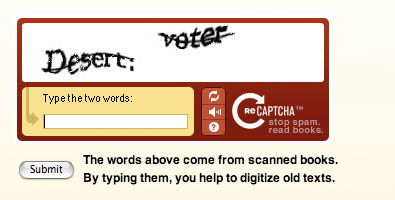
On another issue, the SPAM problem on the Internet became a major problem: Prorams try to make believe that they are human beings in order to insert advertisment anywhere a user can write (in the messages of a forum, in the comments of a blog, etc). For some time now, it became common that human users must identify themselves by their capacity to recognize a badly written word. Theoretically, this is a very efficient Turing test allowing to differentiate a human from a machine only by the results of their actions. Practically, the abilities of software programs have become so impressive that SPAM is slowly coming back again through those filters named CAPTCHAs (those images that you must read and copy back in order to be identified and approved for a specific action).
The problem appears to be: create CAPTCHA tremendously difficult for the automated software and, simultaneously, bring human beings to the task of checking scans of documents difficult to read by program.
The idea is to provide a CAPTCHA service to thousands of bloggers and forum administrators (WordPress, phpBB, etc.) Users are invited to recognize two words specifically difficult to read (profesional OCR programs failed during scans done by Carnegie Mellon University). The user must recognize them both. One is used to check that this is a human being, the other will fill a database of OCR translations that will be used to deliver even more CAPTCHAs and to improve the quality of a document scanned by Carnegie Mellon. Dual core technology: efficiently fight spammers and deliver millions of human users to improve the scan quality of thousands of ancient documents (without using slave labor).
Example of a difficult to read/scan document:
One of the key advantages is that most pro OCR programs can tell when they fail to recognize a character or a word (when they are not confident enough).
Canis pneumatis, or the common balloon dog, is a creature whose anatomy was not too well understood. Up to now. Today we have the first detailed poster about its anatomy.
Friday spare time (or spent time) is back and here is a new way to be unproductive (Shame on you!).
Your objective is to move the little blue-silver sphere through mazes, boxes, lakes and crates to the salvvation of the vortex (in limited time).
Are you able to be the silver sphere hero? Will you resist the urge? Will you be responsible?
Legal notice: I shall not be legally guilty of disturbing company workforce or of inducing a reduction in productivity of people unable to meet their professional deadlines.
Giraffes are endemic in all Africa. So, it’s no surprise that we can find some of them in South Africa. I suggest that you admire the softness in the eye of the giraffe.
Giraffe (male)
Giraffe (female) (Click on the thumbnails to see the larger image)
The technique of Slow synch flash is somewhat difficult to master and this is why I invite you to check the Digital Photography School and its article about it: Slow Sync Flash.
I finally cracked and bought a new screen to replace my main working display. I chose a Dell 2407WFP to have a large work surface (1920 x 1200 in 24″), a wide form factor (useful to push the Photoshop tool bars to the side -they use up a tremendous space on a 4/3 screen), a display quality famous for photography as well as video games (for this, I will certianly be limited by my current ATI 9800pro AGP graphics card that is not really up to the task of 3D display on such a large screen resolution).
Delivery was -as expected- done under 10 days (despite the presence of bank holidays in the delay, the LCD display even arrived three days before the deadline). There is no doubt that Dell has considerable expertise in shipping and delivering computer products and this is easy to perceive here (including the fact that they do not overestimate their possibilities by announcing an optimistic 24h delivery time like so many others).
Unpacking was trivially obvious. I was even positively surprised by the quality of the unpacking instructions (color photos, clear explanations, etc.) and by the light weight of the screen (even knowing that LCD displays are lighter than CRT screens…)
Curiously, nearly simultaneously, I saw press releases about new screens in this interesting size: an ACER screen, the X241wd which should reach 500€ or 550€; the first 24″ with a 2ms LCD from Iiyama (ultra-fast, if you believe the manufacturer specification).
My first impressions are very positive. Obviously, the work space has grown from OK (on the old Hyundai ImageQuest Q17 17″ LCD) to really vast and confortable (on the new Dell 2407WFP). This is real luxury and I think that I will grow the habit of not keeping windows fully maximized but stacked in the screen real estate. For the time being, I am even keeping the 17″ as a secondary along with the Dell 2407WFP. It allows to keep a few utility programs always available.
The first feeling comes from the nice black of the screen (even though there is a very slight glow on the right side when displaying a fully black image, which is not perceptible as soon as the display is lighter). But my first reflex has been to push the brightness down to the minimum (As for many LCD displays, the backlight feels too powerful for me and a use in a moderately lit room).
Color quality seems good right out of the box, but I did not do any serious check. Let’s wait for the results of a complete color calibration later this week.
As I spend a lot of time and energy playing with S.T.A.L.K.E.R. – Shadow of Chernobyl (a Doom-like FPS video game for the PC), I immediately started to check its behaviour on such a large screen. The first constraint is that I need to play with a lower screen resolution (my old ATI 9800 pro AGP graphics card is not able to handle a 1900×1200 resolution – I need to go down in quality to ensure that the frame rate is not too low). The comfort of a huge visual field (24″ is big!) is easy to appreciate. But I will wait a little more until I climb up the graphics performance ladder with a graphics card more in line with the needs of such a screen (probably either an AMD Radeon HD2900 XT or an nVidia GeForce 8800 GT/GTS).
“What’s my line?” was apparently an American TV show of the siwties where contestants were asked to recognize the guest star by asking questions that had either Yes or No as answers. This time, the guest was Salvador Dali. You have to admit that the vast diversity of his activities and of his abilities make the game real tough.
This is the right question to ask. I waited quite some time before writing about a bizarre issue with Windows Vista. Initially I thought that it was a small bug to be quickly corrected by Microsoft: file copying, file deleting and file moving is apparently very slow in Vista. When we say slow, understand “10-50 times slower than in Windows XP”. Normally, this is a nearly impossible change between two versions of the same Operating System (XP and Vista) and such a bug should be corrected quite easily. But it seems that Microsoft is unable to explain what is happening (let alone correcting the issue).
This is so abnormal, that I start to kick the paranoid mode in. One of the explanations I heard is that if Microsoft is unable to go into details and does not bring a solution is because this is not a bug but a side-effect of an intended feature. The most probable thing coming to mind: Windows Vista includes an extension to the file system that allows to handle more directly Rights Management (DRM and similar). In order to do this, they have to pay a price in performance whenever we want to access to a file.
So, is the long-copy/long-delete bug actually an intended feature of an Operating System hiding more and more anti-user devices? It is the more possible if you remember that before Vista launch Microsoft touted the feature allowing to add a peremption date to files (”file auto-destruct on 31st December next year”) or to limit access to only a limited set of users.
You should always read signs carefully. Those are a good example coming from an (Irish?) pub. I guess that the patrons have fun all night long just listening to the shouts coming from the Men’s Room and the Ladies’ Room.
In our series of market predictions, here is an article at The Guru of 3D (titled “LCD TV prices hit bottom“) that explains why, according to iSupply industry analyst, the LCD TV sets won’t go much lower in the near future.
This rebound of LCD bare screens prices will probably have an impact on wide-screen LCD displays (16/9) for personal computers.
The recent news lead me to talk again about digital music and its cohabitation (or lack of) with network technology. As a matter of fact, we learn this week that our new French President is in favor of a strong action against pirated music and downloads. This is not very new, indeed, but the confirmation came from Nicolas Sarkozy quite early after his election. Nearly simultaneously (I see nothing more than a coincidence), Amazon just announced that they would start a new service of online digital music sales that would do completely without copy-protection system (DRM or Digital Rights Management) and would go 100% MP3-only. This is supported by EMI that decided to provide tens of thousands of music titles out of its international catalog.
I admit easily that I am not surprised to see a politician posturing as is expected from his image and adopt an attitude that is based on perceptions but ignoring technical and commercial realities. Nicolas Sarkozy is playing his part in the show as a right wing leader decided to fight all kinds of illegal activities. Nobody should be surprised here. But I contend that this is already an echo from the past and he is missing the light of the future.
Exactly on the opposite, Amazon recognized the commercial reality: Customers do not want those technical anti-copy measures. They go against the legal user (the illegal one does not even see this in the illegal but free MP3 files, of course); They do not stop industrial copy and intense distribution on the P2P networks for example, but they stop the buyer from playing the music title on a player that is nto pre-aprpoved or on the PC of the son’s bedroom, or on the CD-player of Mom’s car, etc.
Amazon, understanding this reality -and certainly also aware that online stores without DRM have better sales/user figures than the others- decided to go and fight directly the current leader of eMusic, Apple iTunes.
Wish them luck! If there will always be poor teenagers ready to sacrifice quality, ease of use, ease of purchase, elegance of the package, etc. (didn’t we copy LPs on dirt cheap tapes when we were young?), a good product will always be a hit.
And if some people insist on telling that the competition of a free product (illegal downloads) can only kill paying products (online music stores), I invite them to consider the tough/relentless competition between a product with a (very very high) price as bottled water and a product (nearly) free like tap water available in nearly all homes (at least in the developed countries). As far as I know, Perrier, Dasani, San Pellegrino, Vittel, Volvic et al. do not petition for a law prohibiting tap water. Those companies and brands offer a product with very notables advantages and make a nice profit out of it.