That is the very interesting question answered in this article from Slate. Whatever you think about corridas (Spanish bull fights) it may be interesting to look at the consequences of being gored by a bull, like it happens in the encierro of Pamplona (when they free the fighting bulls in the streets to have them run to the bull ring).
When you’re an old user of Pegasus mail like I am, you see no reason to loose your old and faithful configuration when moving from one old PC to a newer one as I just did. But this kind of migration does not seem to be an option in the installation. However, following these instructions will allow you to do it transparently:
Normal installation except that you have to ensure that the new location is the same as the original one, for me: C:\Program Files (x86)\PMAIL or C:\Program Files (x86)\PMAIL (instead of the default C:\PMAIL). Don’t forget to refuse the option for autoconfiguration of one user.
At first run of Pegasus mail, it will offer to configure one user space. I asked the same configuration as the original one (single user as offered as first choice) with a mailbox in C:\Program Files (x86)\PMAIL\MAIL. Then, I accept every default option without worrying too much.
Close Pegasus mail
Copy the desktop configuration and the mailbox contents, by coping the contents of the original C:\Program Files\PMAIL\MAIL
Check file C:\Program Files\PMAIL\MAIL\PMAIL.INI that must always have the right description of run data with the right installation directory: C:\Program Files (x86)\PMAIL\MAIL\Admin
Then, you can re-start Pegasus mail to recover the exact original configuration. So, I could recover my 400+ mail folders, my archives, the configuration of all my mailboxes, the configuration of my SPAM filters. Only one thing: The presence of the 3 welcome messages from the Pegasus installation in the inbox. I could easily wipe them out after reading them.
As the most attentive of the readers will have noticed, there was a minor change to the layout of the web site. It should improve slightly the overal performance and it will allow further evolutions that may be appreciated later.
If you find some technical difficulties with your browser (it shouldn’t be the case, of course), please, feel free to comment about it.
For those most technologically inclined, let’s just say that without seriously changing the appearance, we went from template a fully based upon HTML tables to a CSS-based template. Many of the layout elements are now moved into the CSS sheet and this explains the performance gain.
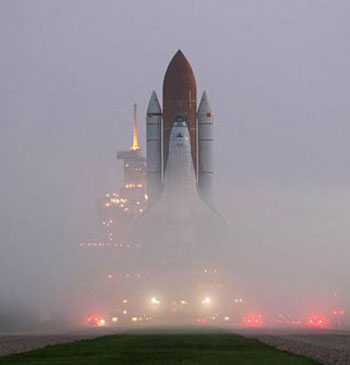
There are no video effects, of course. It really flies, but it’s not a new helicopter prototype of Russian origin. Would you recognize how if stays in the air?
Accoridng to a recent report from NASA (or more precisely according to a single paragraph of that report), alcohol is circulating freely among the astronauts and most specifically during pre-flight. To the point that some worried that the state of the crew may endanger the mission itself. But local management did not seem as worried as others and no flight was cancelled or delayed for such reasons. We do not even know which flights were subjected to this infamous situation or what individuals were involved…
The Register even worries about the impossibility to chek these very incomplete facts. I would tend to follow their opinion. Nobody knows what kind of alcoholic state was observed and who did it or let it happen. It looks a lot more like a unlucky scoop than usable information.
Nevertheless, this won’t help the American space agency regain favor in the eyes of the general public. We will certainly never see the steely courage of astronauts with the same admiration if we believe that it draws more from booze than personal strength. Will we see the apparent hesitation at ignition of some rocket motors as the imprecision of the drunk mass trying to hit the ‘Go’ button? We certainly need to have a more positive hero image and we may find it in the new pioneers of Virgin Galactic and Space Shit One teams in their proud attempts to create a commercial and touristic space market (incidently they have been hit hard by a recent accident that killed three people a few days ago).
The stock exchanges have been subjected to hard winds this week, as it was expected by nearly all the expert analysts. I find it quite interesting that so many observers who are also actors on the market were able to forecast accurately the crisis but were not able to anticipate it enough to avoid it. It looks like a kind of blindness: I know that I’ll miss the next turn, but I keep pushing the pedal down.
The NASDAQ and Dow Jones went down. The CAC40 Paris index fell -6,5% in a week (my own stock portfolio did -4,55% on the same period and I had already protected a lot of it in a national fund (Livret A, much more stable in those hard times)). The newspapers and journalists run aournd it in circles while shooting “we saw it coming” and repeating their mantra (”be selectve in your stock picking” which means don’t buy junk; Isn’t it a brilliant financial insight?).
I find it funny in this mini-crack context that some technology-oriented web sites started crying because the stocks from Intel or AMD went down. I won’t give names, but they completely failed to notice that it was not a problem with the individual stock but a market pushing everything down. Nothing frightening for the electronics giants, unless your analysis is really audacious or really ill-informed about the mechanisms of financial markets.
Sigma recognizing that the current pricing of its SD-14 is setting it a little out of the competitive market for digital SLR cameras, decided to drop it to $1200.
John Chambers, CEO of CISCO, the company that bought Linksys in 2003, informed us that the Linksys brand will soon be abandonned in favor of a new line of routers all named CISCO.
The Linksys brand had been around since 1988, it had been kept because it had a higher recognition factor in the small router market and public. But it must no longer be the case and Cisco is pushing for a convergence between all Cisco-branded products.