(Friday, February 29th, 2008)
In order to easily realize good panoramic photos, it is not enuogh to have a good software package. You also need good images to start with, or the shooting results may degrade significantly the results.
Some easy-to-follow advice:
- Start using the Auto exposure mode of your camera, then switch to Manual to shoot in these exact same conditions (of course, the ambient light must not change, so don’t wait too much and avoid times when light is changing quickly -sunset, storms, etc.).
- Use a tripod, but if there are not too many objects in the front of the subject don’t worry about computing the exxact optimcal center of the camera+lens.
- Disable the autofocus after setting the focus correctly and maintin this focus position on all the images.
- Do not keep the Auto White Balance on the camera. Instead, select one single WB mode that will be used on all images.
- If you do a horizontal panorama, shoot in vertical (portrait) orientation (to increase the usable surface and to improve the final resolution).
- Make sure that you have a wide cross-image section to ease the merging process. The merging software package will thank you.
Find more stories in Photo, Tech, Use your D-SLR
(Thursday, February 28th, 2008)
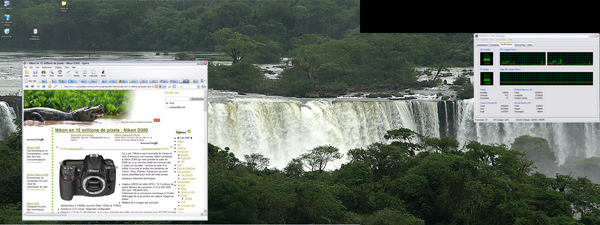
If you have two displays on your Windows PC, you probably noticed that it’s difficult to get a nice background wallpaper cover both screens. Not two copies of the same wallpaper, but one paper stretching the full span of the screens.
For this, I found a good little free utility: DisplayFusion.
Highly recommended.
Find more stories in Graphics & display, Windows Vista
(Wednesday, February 27th, 2008)
It is easy to find the two main characters. But did you notice that there is a total of nine human representations in this painting?
How much time will it take for you to find them all?
Find more stories in Optical illusion
(Wednesday, February 27th, 2008)
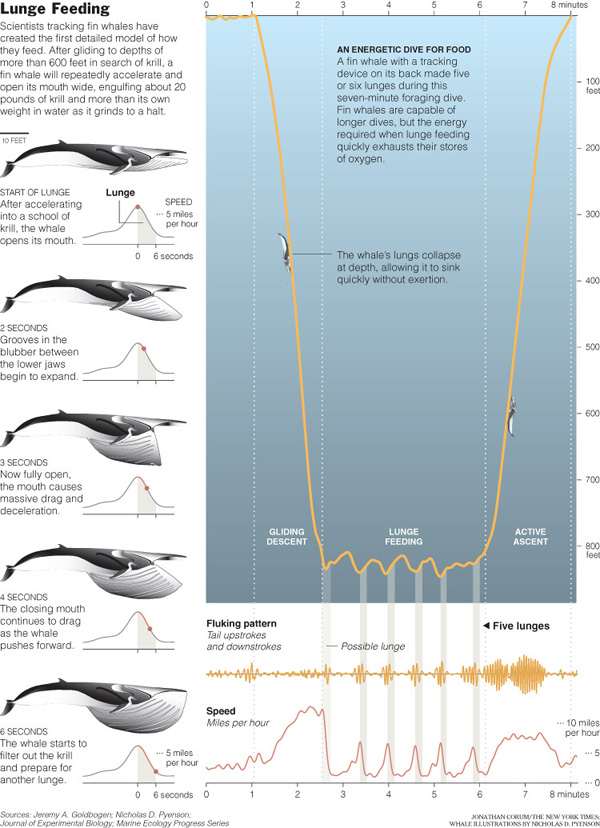
Up to recently, scientists did not really know how whales could eat the enormous amounts of krill they need to feed a record-sized body. It appears that this is now understood thanks to some serendipity.
Sources: The New York Times article and the original paper of Jeremy A. Goldbogen, Nicholas D. Pyenson & Robert E. Shadwick.
Find more stories in Sciences, Whale
(Monday, February 25th, 2008)
You may not have the time and money to go to University lectures. But there are other open options that the Internet is now offering. Many universities and famous institutions provide free online lectures. Let’s browse a few of the best ones I could find:
I could also advise you to check the Lecturefox Blog with a lot of information about these free lectures.
Find more stories in Books, Culture, HR, Legal downloads, Lists, Sciences, Web sightings
(Monday, February 25th, 2008)
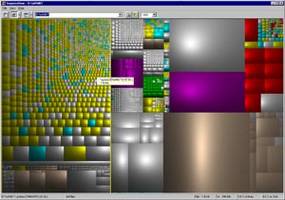
Your hard disk drive is a black box in more meanings than one. Wouldn’t it be pleasant to be able to directly visualize its contents? That is the core of the following proposal: an external hard disc drive whose surface is covered by an OLED screen used to display a treemap contents like it’s done by SequoiaView (see the example here showing the contents of a large disc drive containing hundreds of small files and a few bigger masses).
The display is slightly different, but takes advantage of the same principles and gives you a direct perception of the internal status of your storage media. It reminded me (in a more practical way) the slightly silly proposal I saw a few weeks ago, of a USB key chain that would physically inflate as you fill it with data.
Source: TUE.nl.
Find more stories in Advertising, Storage, Tech, Uncategorized
(Sunday, February 24th, 2008)
As everybody is starting to understand that Blu-Ray won the Hirez battle for the next generation DVD format, the other contender is seeing its products dumped en masse on eBay. If you (still) want to buy a HD-DVD player, it’s your lucky day. Go to eBay auction outfit and you’ll find dozens of players for unbelievable prices.
The only catch (and the main reason): Nobody in their right mind would want to get stuck with HD-DVD technology while its father (Toshiba) is expected to be ready to announce its demise.
Find more stories in Cinema, Culture, Enterprise, Entertainment, Film, Movies, Tech
(Sunday, February 24th, 2008)
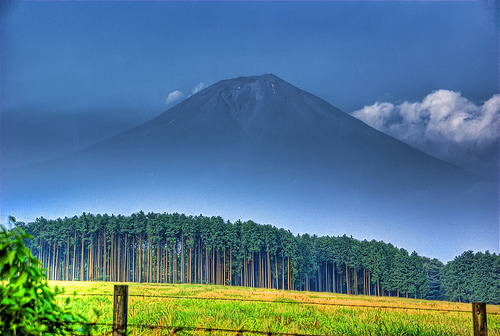
HDR photography (High Dynamic Range Photo) is a process where you take several photo pictures with very different exposures (different speeds or different apertures) and then use a software to pack them into one image packing the whole range of light. The result is often a little erie but allows to take images impossible to catch in any other circumstance.
Good examples come from the Japan HDR group on Flickr, like the following.

But if you want to test your capacity at this, I suggest you dig into the following links:
Whatever your software package, you should find something to use.
Find more stories in Art, Culture, Photo, Photo & Graphics, Portfolio, Tech, Use your D-SLR
(Sunday, February 24th, 2008)
Did you know that, before the actual deployment of radar, the localisation of flying planes was done by listening to them?
With a good sound mirror, you could hear the motor of a plane from very far. And a sound mirror is essentially a wall able to reflect sound (like in a subway station or the underground cathedral of Brazilia). As you can see, some have tried to apply the idea to a portable device (don’t you like the way the listener looks?)
But, the larger the reflection device, the more amplification power and the more frequencies you can catch.
In front of the Channel, in United Kingdom, the Royal Air Force installed such devices of increasing sizes. The largest one (see below) was more a wall than anything else.
(more…)
Find more stories in Security, Tech, Uncategorized
(Saturday, February 23rd, 2008)
If like me your a photographer who wouldn’t dare making a video, you still can think about doing a decent time-lapse sequence out of your photographs. However, this cannot happen just by taking images and loading them into a software.
You must start by studying the lessons from PhotoJojo.com’s Ultimate Guide to Time-Lapse Photography.
When you think that you’ve mastered the technique, you can think again and look at the following example created by Lucas Oleniuk, photographer of the Toronto Star. Taking 20,000 of his still photographs, he built a 20-days sequence re-hashing the issue of global warming for us.

Direct link to video
Find more stories in Art, Cinema, Culture, Film, Movies, Nature and global warming, Photo, Photo & Graphics, Portfolio, Sciences, Use your D-SLR, Web sightings
(Friday, February 22nd, 2008)
A German vertically-challenged worker is the pilot of the mechnical doll that we name président G.W.Bush.

video link
Find more stories in Entertainment, Film, Movies, Social issues, Uncategorized
(Thursday, February 21st, 2008)

Click on the thumbnail image to enlarge it
Sunbittern (Eurypyga helias, Caurale soleil). Brazil, 2007.
Find more stories in Birds, Photo, Photo safari