Out of Canon, nobody seems to really have a clue about what will be the successor to the Canon EOS 5D. Most people assume that it will be named either Canon EOS 5D Mk II (the most probable possibility according to several sources), Canon EOS 6D or even Canon EOS 7D. However, this does not stop experts and not-so-experts to make various assumptions about what specification it will have.
Taking into account the existence of the Nikon D3 and its impressive set of features, Canon sure has to prepare a top-of-the-line DSLR with a superb Full-Frame sensor, with outstanding image quality. Of course, this is a normal (but difficult) target for the leader and the company that drove us into the Full-Frame world. There, we found: large pixel counts, exceptionally low noise levels, very high sensitivity and a normal 1-to-1 conversion factor for lenses. This last item may not always be a positive (for example, long tele-lens lovers appreciate that a smaller APS-C sensor transforms your common 300mm lens into a loveable 450mm optical gun), but the rest is a boon for photo quality. And there, as the Canon EOS 5D then the Nikon D3 proved, there is a giant step to be taken from more common DSLR.
So, it should be no surprise that photo-related forums are dripping with more or less reliable comments about what the Canon EOS 5D Mk II will be. Possibly, we will see specifications around the following:
15 to 16 MP sensor (good but not oustanding, in order to hit hard on image quality; Enough to top the 12MP of Nikon D3) with 14-bit A/D conversion (the de facto standard of Canon image quality)
ISO 12800 (boost up to ISO 25600) that should give Nikon a run for their money
All-new 29-point TTL CMOS AF sensor (needed to compete with the impressive 51-point AF sensor of Nikon)
6 fps continuous shooting (for more than 50 frames)
Lens fine adjustment setups for 14 lenses
The rest should be more predictable and does not request a crystal ball (sensor dust cleaning, improved 1MP 3″ LCD screen, LiveView inspired by cheaper DSLR models, weather sealing that was lacking from the EOS 5D). But there are two important elements left out of this picture:
The price target would be around $3500 (to be compared to the $5500 of the Nikon D3), definitely strong positive argument for Canon even if this is still targetting pros and rich amateurs;
The announcement would be made in April 2008 (may be, not as a Fool’s Day joke) for availability before mid-June.
These last key arguments could prove critical to offer a very good position to Canon. They had the first Full-Frame DLSR camera (the EOS 5D). Now, Nikon is trying to grab the market with the Nikon D3 since last November. Canon has to hit hard in order to keep the upper hand and they cannot wait for some pro photographers to switch (even if this category of customers cannot jump out of the train each and every year like some enthusiast consumers). Moreover, we know that Sony will be soon arriving with a new Full-Frame DSLR based on a 24MP sensor presented a few months ago (rumoured to be named Sony Alpha 900).
It’s time for Canon to shoot a star. The Canon EOS 5D history needs a sequel to become a real Full-Frame saga. The Canon EOS 5D Mk II could be this long-awaited beacon for the highest end of the Canon DSLR line.
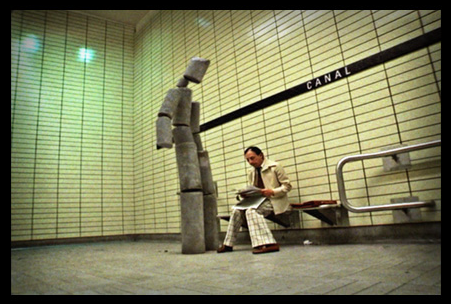
Trevor Cawood is a movie director that has been noticed in a number of short movies in the world of advertising. Personally, I noticed ads for Citroën and for GMC. But you must remember him for his participation to the special effects of The Matrix Reloaded (Matrix 2) or The Matrix Revolutions (Matrix 3). But in 2007, he directed this short movie that I found some time ago.
Synopsis
A mere business worker seems to be choosen by an impressive creature of cement (a golem, maybe). Permanently stalked and followed, he has to learn to live with it.
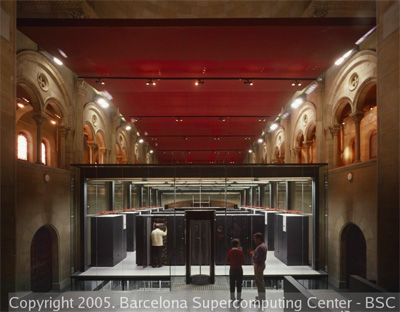
The most powerful super-computer in Europe (and the 13th in the World), MareNostrum, is located in Barcelona, Spain, and has been installed in an old chapel. This gives us the most beautiful supercomputer in the world (this is nearly computer soft-pron photo).
Sometimes, the economy is not faring well, sometime it’s too good. In both cases, it may lead to astonishing bills. I found some cases, I really loved.
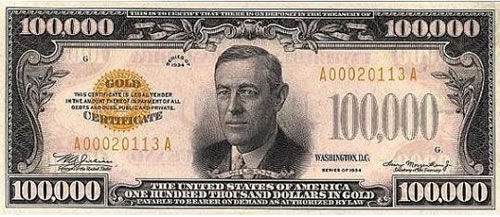
The biggest single US dollar bill
This is not even really a bill since it’s more a tool to manage gold exchanges in an economy that was based on gold: a gold certificate. It was never circulated in the public since 1034, and is only visible in museums.
In a country where the economy totally collapsed, the Zimbabwe dollar has no value left: Inflation reached several tens of thousands of percents (much more than what hit the German economy of the 30′s), crushing the mere value of any bill in just days.
As a matter of fact, this 10 million dollar bill does not allow you to pay anything (valued a few euros a few months ago, it’s really worthless now).
Your good old laptop PC went back to meet its maker and you can’t accept the idea of dumping it into the next waste basket (not even considering recycling, would you really want to part in such a harsh way?). Let’s not forget some of the few uses that you can still have from the old mate:
What broke down:
You still can…
The screen is all dead and went black
…attach a desktop display and convert it to a small desktop PC.
The screen is all dead and went black
…install Linux, an SSH_server or PC_Anywhere and recycle it into a autonomous file server with low power consumption.
The motherboard is resting
…scrap the 2.5″ disk drive and put it into a nice little USB box to have a new external backup solution.
The battery is out of juice
…plug the power cord and convert it to a small desktop PC.
The keyboard is broken
…install Linux and recycle it into a autonomous file server with low power consumption.
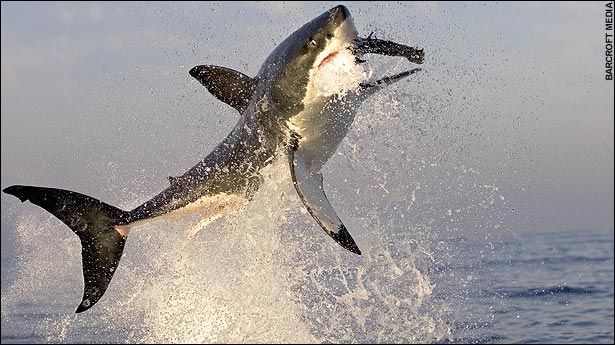
Most people are amazed by the power of the marine predators that are most sharks. While it is often difficult to catch them in the act, there are a few occasions where it is possible to see impressive animals. Recently I found some that I wanted to share with you.
Of course, you know it, a photo tripod is an excellent solution to stabilize your photo camera and get crisp images despite a long shutter time (or a trembling hand). But there are other simple solutions that you should keep in mind:
A photo monopod: After all, one leg (instead of three) can be enough, even more if you push the camera against another fix support (a wall, for example). and, the monopods are lighter and cheaper than photo tripods.
The bean bag: It’s only a bag filled with dry beans or grain; The result is a deformable and stable base where you can easily push a camera into. Even a heavy one.
The self-timer, shutter-delay, remote release function of the camera: Most of the camera moves come from the photographer pressing on the shutter release button. Why not use the self-timer integrated in your camera (even if the supporting base is not very stable, it will improve the situation a lot)?
Several images: I use it a lot, shoot three images in a row using the auto-drive of the camera; The first one is most influenced by pressing the shutter release button, but the next ones are better.
In-camera shake reduction: Yes, it is included in the camera system just for this purpose. Be it part of the lens (at Nikon, Canon, for example) or of the body (at Sony for example), it brings between 2 and 4 speed stops. But sometimes, you may have to take seevral photos to get one really good (when you are bordering with the limits of the system).
Hold your breath: And press the button just after blowing slowly al your lungs air; It’s an old and reliable solution and it works.
Last but not least, do not forget that if the subject itself is moving (and the camera is already stable) there is no other solution than a fast shutter speed (or flash light).
I just discovered (I have to admit that I had not to look very far) a small feature of the Opera browser (from version 9): the voice interface. This is fascinating, Opera accepts voice commands and can read the contents of a web page.
You have to first install a small add-in module (that is immediately downloaded from the Internet and available from a button in the icon bar of Opera) to reach these features. After a few seconds or minutes, the Internet user will be able to use his or her browser by pressing on a key to start the browser listening to your orders. Simple: Insert key, Baby open page, Insert key, and a new page opens. You must keep a relatively good American English accent, but it works quite well (even with a lot of background noise).
On the other side, you can request Baby read to listen to Opera reading the first lines of the page or the selected paragraph you previously selected.
Nota bene: I told Opera that I prefered to use Baby as a prefix to all commands rather than the bland Opera prefix; I find this cuter.
A feature that you must try too. In a free browser of very high quality.
A zoo cheetah cannot be released in the wild if it is not able to hunt. And this is the fastest running hunter – if trained. So, how do you exercise a cheetah in order to prepare it for possible wild life?
If you want the best possible Flash memory storage for your camera, you need to look for a good Flash memory card. But which one is the best? Just look at those tests:
And remember that the fastest memory cards are no longer needed if you are not using one of the biggest SLR cameras and in RAW mode. However, a fast memory card is still useful to get the data into Photoshop (if you have a really good flash card reader on your computer, not the first 13-in-1 USB reader on eBay).
With VozMe, it’s easy to have your computer read a text. In English (but also in Spanish and in Italian), you will get an MP3 file with your text read by the slightly-metallic voice of your computer.
One of the greatest minds and authors of the 20th Century just died. Arthur C. Clarke was very well known for some of his highly acclaimed books (think about 2001: A Space Odyssey and the collaboration with Stanley Kubrik on the movie with the same name). Some of them were only known to Science Fiction fans (Rendez-vous with Rama, The Fountains of Paradise, for example).
But Sir Arthur C. Clarke was also the author of significant steps for science like the observation that geostationary satellites would be the practical solution to many telecommunication issues. I can vividly remember my reading of Interplanetary Flight; an introduction to astronautics, where in 1950 he stated very clearly concepts like the multi-stage rocket or the geostationary satellite and why they should be prefered to other technical solutions.
The old man (born on 16 December 1917) was living in Sri Lanka where he appreciated the leisure of all-year-long scuba diving.
Science Fiction can no longer be the same after he left us.
Arthur C. Clarke died at the age of 90 from respiratory complications linked to the post-polio syndrome that forced him into a wheelchair for his last years.