(Monday, May 5th, 2008)
In September 2007, the Inspector General of the Justice Department reported that the Terrorist Screening Center (the FBI-administered organization that consolidates terrorist watch list information in the United States) had over 700,000 names in its database as of April 2007 - and that the list was growing by an average of over 20,000 records per month. [1]
Interestingly, this statement allows to believe that by June 2008 the list will have grown to 1 million terrorists in the US of A. I believe that Americans can be silly, but I doubt that one out of 230 is a dangerous moron attempting to end western civilization next time he or she will take a plane.
I suggest that you have a look at the astonishing list of “unlikely suspects” displayed in this article from ACLU. It includes US Senators and US Congressmen (and their spouses), war heroes, John Does with a common name, dead 9/11 hijackers, foreign presidents (dead as Saddam Hussein or alive like Evo Morales), pop star singers and toddlers.
Find more stories in Liberties, Lists, Security
(Monday, March 17th, 2008)
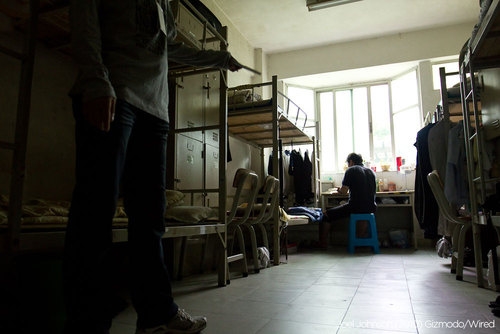
Most people did not really notice this bit of information: The United States of America reached a point where 1,6 million Americans are in jail. This is nearly one percent of the 230-million population.
I am starting to believe that this is (maybe not only) a way to manage a significant part of unemployment. When a society has 1% of its people behind bars, this is becoming not only a marginal management of violence but a strategy to economic management of population. One of the first advantages there is that it has a visible impact on unemployment (jailed people do not look for a job).
Has jail become a nation-wide population control system?
Source : Neatorama.
Find more stories in Jobs, Liberties
(Friday, March 14th, 2008)
Long ago, I had already published the old Copyright FAQ (”10 Big Myths about copyright explained” * by Brad Templeton), but here is a good post from PlagiarismToday: “10 Basics About Copyright Everyone Needs to Know“.
Find more stories in Culture, DRM, Internet, Legal downloads, Liberties, Web sightings
(Tuesday, February 12th, 2008)
If you want to do discreet (if not completely anonymous) P2P, Bittorrent and Gnutella or Kazaa are not your friends. With the advent of more attention from authorities, it is difficult to consider them as good opportunities.
I have been looking quickly at some of the possible solutions to protect your privacy while exchanging files over the Internet. I found the following ideas:
- Omemo is a recent Spanish development. I tried it and it is very obvious that the program is still in beta. Essentially, I was unable to download a file if it was not very small in size or to upload any. Let’s wait until it works.
- GigaTribe seems a good solution if you are willing to pay for the Premium package. It builds a closed network with your friends, but the standard (free) software is not able to grab files from multiple computers at the same time. So performance is very limited for the free version. GigaTribe3 is said to correct a number of issues some time later in 2008.
- Freenet is rather difficult to use at first, but if you run Thaw, one of the applications provided at installation, you will get a large choice of file downloads and performance while limited is not ridiculous: A few days for 2GB of video, it could be much worse. However, some may be troubled by the kind of data found there: While the common P2P data can be observed, you will also find conspiracy-related information and a quite significant load of pornography and child pornography (normally not found on the more open Internet).
I don’t know where the future of P2P lies, but it is certainly around some of these darknets (networks that are protected from external Peeping Toms). Freenet is supposed to be the best and most secured one, even if it is not perfect (it seems clear that some powerful agencies have setup some Freenet nodes in order to be able to spy the traffic).
Find more stories in Internet, Liberties, P2P, Routers & networks, Security
(Saturday, February 9th, 2008)
The TSA (or Transportation Security Administration) is in charge in the US of the organization the safe transportation of people in planes and through airports. Unfortunately, either they have a lot of other responsabilities (which is true) and fail at this one (which is also true), or they utterly incompetent at insuring the security of the passengers (true again).
I have been amazed at the number of horror stories that I could find lately about their abysmal track record, so here is a short compilation I made just for your your laughs (or cries).
- TSA has opened a blog web site. It was supposed to help passengers. It has been the focus of a lot of attention from Internet users. They recently apologized to the blogesphere (sic) for arbitrary gadget screenings (at least in San Francisco SFO, they required all electronic devices and cable to be removed from bags for screening)
- TSA has a no-fly list of people who should not board airplanes for fear of terrorism. This list is a shame since it contains tens of thousands of names remotely linked to terrorists (if they are dead, like Mohamed Atta known for dying on 911, they do not even get removed from the list) and even very common names are included making the life of thousands of innocent people impossible in airports. Like Sam Adams, 5, probably very dangerous despite his nice smiling little face.
- Speaking of faces, TSA started to train its screeners with some facial expressions that are considered ground for additional screening and interrogation (in a program called SPOT (Screening Passengers by Observation Technique) probably only a thin veil on “let’s stop this guy because I don’t like his face“). Unfortunately, they would not say if you should avoid smiling or making faces to the TSA personel. After that, you immediately think about George Orwell’s 1984 (”facecrime”) and Kafka’s Trial (not to speak of stalinist behavioral crimes). And when you see how untrained the screeners are…
- Speaking about training, should I mention the cases where the agents are so unable to handle your belongings that they drop them on the floor. Don’t mention dropping a T-shirt. Think about pro-photo equipment like here or here.
- TSA and some English goons decided that transporting liquids was a major terrorist danger. Even if it is the milk bottle of Junior, the Coke for Dad or the Perrier for Mom. So, now, liquids in more than 100ml are prohibited from your carry-on luggage (even though it is more or less admitted that the threat was exagerated). Except if they are in a clear plastic bag. What has this to do with security? Does it make a difference between the following two eye mascara sticks?
- Even pilots are annoyed at bullshit “security” procedures that the TSA has put into place. [The linked article has interesting references to British Security officials admitting that the “liquid bomb plot” public statements were overcooked, inaccurate and “unfortunate.”
- The TSA web site supposed to help people request their removal from the no-fly list has been demonstrated as a major Internet security risk, it looks more like a scam with all the security errors/snafus than an important US national asset handling personal data.
- Sometimes, you can get stuck on the no-fly list for unobvious reasons. Like artist Ramak Fazel or singer Cat Stevens.
After that, would you be surprised if I told you that:
Find more stories in Liberties, Photo safari, Security, Uncategorized, Use your D-SLR, Web sightings
(Monday, December 31st, 2007)
Here we are! Transport regulation authorities added the Lithium batteries to the list of banned objects in carry-on luggage in planes.
Of course, Lithium batteries can explode. But they took the additional step of prohibiting them when they are out of the device and contain more than 2g of Lithium…
Photographers leaving for a long trip: Put them in the checked luggage if you do not want to see them ending with fire-arms, knifes, cutters and mineral water bottles (in the junk bin).
Find more stories in Liberties, Photo safari, Security, Use your D-SLR
(Friday, December 14th, 2007)
What could be the use of network hard disk drive of one Tera-Byte which would strictly refuse to serve files because there may be a risk of breaching licensing agreement potentially applicable to them? This is the question that potential buyers should ask before purchasing the Western Digital disc drives using WD Anywhere Access: WD My Book World Edition.
There is a long list of file suffixes that cannot be shared on a network (even a local one) on this type of hard disc drive.
In my opinion, a WD My Book World Edition disc is defintely worthless. You cannot usefully put on it an MP3 file, and AVI file, a TMP file, a QuickTime video or a Windows Media video. Western Digital seems worried that you may not have the licensing rights for these. So they don’t want you to use them. Leave those Western Digital discs at he irresponsible stores which are selling them or bring them back.
Find more stories in Culture, Film, Liberties, Movies, Music, P2P, Routers & networks, Security, Storage
(Sunday, October 28th, 2007)
Year after year, there are a few photo images that wrote History. LukeProg found 52 of them. The choice is always subjective, but most of them really hit the public.
Find more stories in Art, Culture, Liberties, Lists, Photo, Portfolio, Uncategorized
(Thursday, October 25th, 2007)
I was recently confronted (during the preparation of my photo trip to Brazil) to a situation somewhat common. I did not take notice of it before, but I was tickled this time.
Facts first: In order to reduce the cost of lodging during my trip the travel agent offered to share my room with another photographer travelling alone too. It happened before and for a an expensive trip like a phot safari, this can be appreciated. Nevertheless, what had me thinking was slightly different: In this same trip, there is a lonely woman photographer; But the travel agent told me that they could not offer me (us?) to share our room because I am a man.
The implicit reasonning is that the sexual difference could create a problem that the agent does not want to be responsible for. It is still possible to negotiate this in the beginning of the trip though - under our own responsibility.
I was stricken by the fact that it is an a priori position deeply marked by the travel agent hypothesis that their customers are heterosexually inclined. My intent is not to criticize the agent, but to think about the fact that this is a preconception shared by the general public and reflected in many of our society’s aspects. Sexual tension between two people is only thought as possible between a man and a woman. This is the case when you may share a hotel/lodge room, you separate gym’s dressing rooms or toilets, you have special days for women in a hamam, etc.
Isn’t it weird that this hypothesis is still so common? I mean, after all, our societies ignored (or denied?) homosexuality up to quite recently. But current figures give estimates of the number of homosexual people at one or two millions in France [1], 800,000 among French men between 18 and 69 [2], nearly 1% of Canadian marriages [3], 65,000 in the American armed forces [4]. Simply from these figures, it is easy to state that the mere hypothesis of the absence of homosexuality should be abandonned by our society.
When will we see dressing rooms that are either without sexual distinctions or completely individualized, shared toilet rooms, etc.?
Find more stories in Culture, Liberties
(Saturday, October 6th, 2007)
Find more stories in Art, Cinema, Culture, Film, Liberties, Movies, Security
(Thursday, September 20th, 2007)
This is the calculation done after a poll realised by ORB, the British poll company in Iraq, and asking the following question to 1481 people aged 18+: “How many members of your household, if any, have died as a result of the conflict in Iraq since 2003 (ie as a result of violence rather than a natural death such as old age)? Please note that I mean those who were actually living under your roof.”
The answers:
None 78%, One 16%, Two 5%, Three 1%, Four or more 0.2%
If you use the last census figures (more than 4 million homes in Iraq), it allows to reach 1,220,580 deaths (more than a million, right).
Unfortunately, this is well in line with the figures published at regular intervals by The Lancet (medical journal) that presently evaluates the death toll to around 600,000 from medical data.
The original Deltoid article applies a few additional checks to ensure that this is not skewed and it stays in line with reality (you should always have that kind of caution with statistical data), but it is easy to understand why Irakis are not happy with the presence of troops from US, UK and allies. Since 2003, they are reliving the nightmare of the Iran-Irak war, but they are under occupation. Go wonder why they are not receptive to the arguments from the Bush administration…
Find more stories in Liberties
(Tuesday, August 28th, 2007)
Michelle Roohani is not only an interesting photographer that I already mentionned here a few months ago, a good friend, but also able to stir things up a little. In a recent post titled “Suicide, a fundamental right“, she suceeded in promoting a quite interesting talk about a difficult philisophical subject. I think that it’s well worth spending a few minutes there. At least, for the comment thread.
Find more stories in Culture, Liberties, Social issues