Fabian Tischer is obviously gifted to create small videos from visual effects supposed to be simple (but actually quite tough to master) in order to offer us some cool movies:
It’s worth noticing it if you are using Opera. I had a difficult-to-solve issue recently.
While playing with the idea of starting to use IPv6 on my main PC, I tested the waters by validating this option in the network configuration of my Windows XP. Unfortunately, Opera is already fully ready for IPv6 but my router box is not. So, the first effect it had is that Opera decided to enforce the use of IPv6 for all web sites that mentioned IPv6 capacity in their DNS (not many of them, but Google and Free.fr my ISP are already in the list). The immediate effect was that Opera tried to connect to them in IPv6 but failed (because the rest of my home configuration is not 100% IPv6). For 99% of all web sites, there was no difference…
It took me several days (and some Googling – using Safari and Chrome) to understand that this is a known issue and to remove the (still) useless IPv6 Windows configuration.
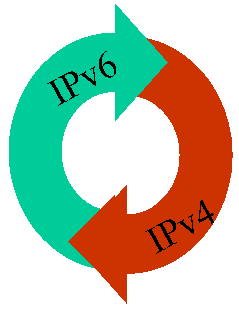
Darwin did not see this. Darwin was too shy when he published his major work “the origin of species” on November 24, 1859. The evolution is also for machines and technology and the struggle for life has a meaning.
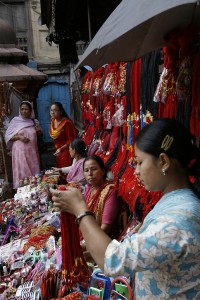
In a Nepalese city, like Kathmandu, you quickly notice that the industry is small but very accessible, meaning that you can walk to the people involved in tradesmanship or craftsmanship. Since most Nepalese people are accepting your taking pictures or willing to see the photos you just shot, it’s very pleasant to shoot such images like the following.
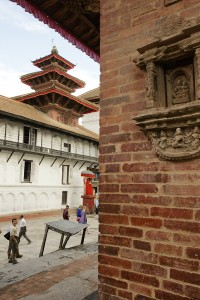
Kathmandu is the capital of Nepal. I stopped there twice during my recent trip to this Himalayan kingdom-gone-republic. The city was pleasant to visit if a bit too loaded with tourists for my taste (the first baseball cap is already too much for me). But I got a few images from it.
Here are a few images of the city.
Click on the thumbnails in order to enlarge them
Tomorrow, I’ll come with pictures of the small shops and skilled tradesman I have seen in its streets.
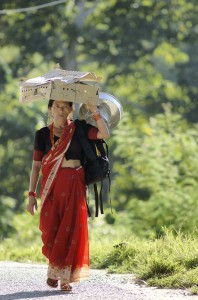
During a (forced) stop in one of the journeys between cities in Nepal when I recently traveled in this Himalayan country, I took a short moment to do some portraiture in the setting sun.
Copyright (c) 2009 Yves Roumazeilles - All rights reserved
Back from a few days of photo trip to Nepal, I feel it is time to share with you some of this astonishing experience organized by Amawanda and guided by Alain Pons.
I am more or less a wildlife photographer attracted to the African wide-open spaces. But I had been attracted mostly by the presence of a seasoned pro photographer (Alain Pons) assisted by a very serious organization (I had been able to appreciate them in a previous trip to Kenya in 2008). I had also noticed that costs were relatively moderate (taking into account that this is a wildlife trip – which is often very expensive) including -we could check this later on location- a significant share reserved for local actions for development and nature protection in full coordination with the local structures and the local wildlife organizations.
A summary of the program:
1 night in Kathmandu in 3*** hotel
2 nights in Pokhara in 3*** hotel
1 night in Lumbinī in 2** hotel
6 nights in Bardia in 3*** hotel
1 night in Kathmandu in 3*** hotel
The flight to Kathmandu was without surprise on Qatar, despite the long night stop in Doha airport where the only Duty Free shop cannot be considered as a commendable tourist spot (but they have a nice stock of alcohol or cigarettes for those who prefer to prepare themselves for later needs).
The Kathmandu-Bardia journey requires about 20 hours of bus or car. The stops provided in the program are a good way to break the inevitable monotony. A faster plane journey would be possible (it is included on the way back) but it would be a pity to avoid the view in the valleys and from the mountain roads out of Pokhara.
All along this journey, I will try to make a few recommendations about what a photographer might find more interesting to stop for.
So, the great FPS game will be back before the end of the year 2009. Either the launch campaign started early in Nepal or the bus drivers are using their vehicles as video game weapons (the latter would explain the extraordinarily high frequency of dramatic road accidents there).
Microsoft Project is expensive, very expensive. But once you started using it, you can’t stand not having a nice clean GANTT project chart. Why not get a free Microsoft Project? Even better than downloading MS-Project for free, I am proposing you to use an on-line GANTT chart/project builder that is completely free and works on-line: Gantter.
Gantter
I have been really impressed by the quality of such a software program. It may need to get some interface polish for Opera users (I had a couple of little display bugs), but the operation is fully adequate for many projects.
Sometimes an image (from Nepal or elsewhere) hesitates on the better orientation to give to the photographer. Which one of these two Nepalese paddy fields would you choose?
Copyright (C) 2009 Yves Roumazeilles - All rights reserved - Click on the thumbnail to enlarge it
The arrival of Windows 7 also annonces the arrival of a new updated DirectX to serve the PC gamers’ community. We already knew that Vista did not have the favour of the gamers (who often stayed with Windows XP) and that had (among other things) some significant impact on DirectX 10 that required Vista. Will gamers now run to Windows 7? It’s possible, but if you want to see the real progress brought to video games (here, to the very popular Crysis FPS) by the various version of DirectX, check the video below:
When visiting Nepal, I could take a plane trip for some sight seeing, from Kathmandu to the Mount Everest (the highest point of our world at 8848m or 29028ft).
Its Nepalese name is SagarmÄthÄ (Nepali: सगरमाथा), and it is very near to the Lhotse, another 8000-summit (precisely 8516m or 27940ft).
Everest and Lhotse
The image here was taken from the pilot seat when we were at the nearest point to the Everest during the flight (click on the small image to enlarge it).
The unlabeled peak on the right is probably the Makalu (8463m or 27766ft). But this needs to be confirmed by somebody more expert than I am.
Are you looking for information and news about digital
photogaphy and digital SLR cameras?
They are now grouped again in my new web site YLovePhoto.com.