The very good anti-virus software got a little better with version 8. But the free version (which made it so popular) is not yet available. For now, you’ll have to stick to the excellent v7.5.
Visibly, in 2008, scammers and spammers start early: The sheer number of emailed wish cards seems to have increased to very high levels. Only one advice: If you receive a “best wishes” electronic card from somebody that you don’t know, don’t even spend time (and computer security) checking it. It’s most probably a mean to insert a worm, a Trojan horse or a virus in your computer.
When you’re an old user of Pegasus mail like I am, you see no reason to loose your old and faithful configuration when moving from one old PC to a newer one as I just did. But this kind of migration does not seem to be an option in the installation. However, following these instructions will allow you to do it transparently:
Normal installation except that you have to ensure that the new location is the same as the original one, for me: C:\Program Files (x86)\PMAIL or C:\Program Files (x86)\PMAIL (instead of the default C:\PMAIL). Don’t forget to refuse the option for autoconfiguration of one user.
At first run of Pegasus mail, it will offer to configure one user space. I asked the same configuration as the original one (single user as offered as first choice) with a mailbox in C:\Program Files (x86)\PMAIL\MAIL. Then, I accept every default option without worrying too much.
Close Pegasus mail
Copy the desktop configuration and the mailbox contents, by coping the contents of the original C:\Program Files\PMAIL\MAIL
Check file C:\Program Files\PMAIL\MAIL\PMAIL.INI that must always have the right description of run data with the right installation directory: C:\Program Files (x86)\PMAIL\MAIL\Admin
Then, you can re-start Pegasus mail to recover the exact original configuration. So, I could recover my 400+ mail folders, my archives, the configuration of all my mailboxes, the configuration of my SPAM filters. Only one thing: The presence of the 3 welcome messages from the Pegasus installation in the inbox. I could easily wipe them out after reading them.
It is well known that the human brain has pattern matching capabilities much further advanced than those of the best equivalent software programs. This explains that failure rates of OCR (Optical Character Recognition) program may be as high as 1% (or even 2%) of errors, which is requiring later human proof-reading to ensure a reasonable quality for document scans. But when the document is old, badly printed, or degraded, error rates may climb further into the unusable (even more so when we address the scan of thousands of documents like is done by libraries and cultural institutions all over the world).
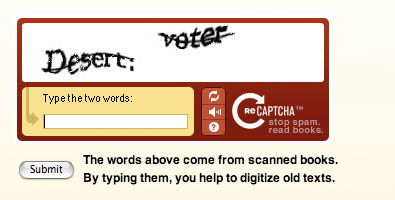
On another issue, the SPAM problem on the Internet became a major problem: Prorams try to make believe that they are human beings in order to insert advertisment anywhere a user can write (in the messages of a forum, in the comments of a blog, etc). For some time now, it became common that human users must identify themselves by their capacity to recognize a badly written word. Theoretically, this is a very efficient Turing test allowing to differentiate a human from a machine only by the results of their actions. Practically, the abilities of software programs have become so impressive that SPAM is slowly coming back again through those filters named CAPTCHAs (those images that you must read and copy back in order to be identified and approved for a specific action).
The problem appears to be: create CAPTCHA tremendously difficult for the automated software and, simultaneously, bring human beings to the task of checking scans of documents difficult to read by program.
The idea is to provide a CAPTCHA service to thousands of bloggers and forum administrators (WordPress, phpBB, etc.) Users are invited to recognize two words specifically difficult to read (profesional OCR programs failed during scans done by Carnegie Mellon University). The user must recognize them both. One is used to check that this is a human being, the other will fill a database of OCR translations that will be used to deliver even more CAPTCHAs and to improve the quality of a document scanned by Carnegie Mellon. Dual core technology: efficiently fight spammers and deliver millions of human users to improve the scan quality of thousands of ancient documents (without using slave labor).
Example of a difficult to read/scan document:
One of the key advantages is that most pro OCR programs can tell when they fail to recognize a character or a word (when they are not confident enough).
You certainly noticed in the flood of SPAMs that is probably arriving in your mailbox as in mine, that many of them are promoting stock exchange securities -that you usually do not know about. This is generally part of an elaborate (but old) scam known as ‘pump and dump‘. It consists in buying shares of a company (preferably on a small market), then to promote it like hell announcing huge value increases just to make it happen (pump) just to sell your shares to the victims while they rush in (dump).
It works best if you attack a company whose stock is circulating in very small quantities (they are more sensitive to small changes of market opinion). You buy at the lowest possible price over a long period of time; You convince your victims that the stock is undervaled and will go up, so they rush and make the stock climb quickly (most victims then become even more convinced that the information was right). But you are the only one able to profit from it since you are the one selling. Later, the victims are left with value-less shares that nobody wants to buy (and certainly not at the price of the recent transactions). The crooks can make a lot of money out of such a scam taking advantage of the individual victims (they gave their money to the scammers) and of the company (it will probably take a long time before the bad reputation earned by the stock at that moment can be cleared and come back untarnished).
The SEC thinks they found the solution: Recently, for 35 companies stormed by such SPAM campaigns, the SEC simply banned trading. It may not bring the complete solution, but it gives time for information to flow and the potential victims to be informed of what is happening before they go and make fools of themselves. The hope is to force scammers to loose their information advantage, leaving them with stock at their real value instead of an inflated one. Normally, the scam works on a period of one to two weeks (a short period of time that is acceptable for a trading ban).
Parallely, the Feds succeeded in catching people that were running similar scam but using hacked brokers accounts.
For once, a scammer let us smile (though against his will). Let’s smile.
Today, it is the 419 scammers that have been baited by an Internet user who decided to have fun with them and convinced them that he would give a lot of money to people who would recreate famous scenes from movies or TV shows. Here, they accepted to play the well-known “dead parrot” Monty Python sketch.
This is pure exceptional anthology. A moment that will stays in the history of Internet scams and scam baits.
As you certainly noticed, we changed significantly the look-and-feel of our web site. The plastic surgeon used its scalpel to give a new face to the web site: reduce the size of the pages (faster downloads for you), improve readability (the white background increases the contrast), come back to a more sober graphic design (only a few graphic signs and homogeneous colours).
But there are some new functionalities too. The most important one is certainly the addition of the ability to send an email to your friends to let them know about a post that you would find particularly interesting (for whatever reason). Just before sending, do not forget to copy the code that is provided (it allows to protect us against robots that would be trying to send automated emails using this form). In any case, be reasonable and polite with your use of this nice little feature.
Just look at the link at the bottom of articles on the front page (or in the box at the bottom right for post pages).
As a matter of fact, the holiday season seems to be a season of SPAM. This web site is receiving again a large amount of comment SPAM. I guess that the spammers are hoping to catch bloggers while they are distracted by more family matters.
Thanks to Akismet for catching all that. I only have to delete the stored SPAM.